
Basics of Coffee
Why the Same Coffee Can Taste Different Every Year
An honest conversation about harvest variation, and how factors like rainfall, temperature, and crop cycle affect what ends up in the bag.


Ethiopia is widely recognized as the birthplace of coffee, discovered by a goat herder named Kaldi during the 9th Century. Ethiopia is the only country in the world where Arabica plants are native, growing wildly in forests.
Although we do not have official documentation confirming who discovered coffee trees, we do have legends that can be used to piece together the history of coffee.
As the story goes, a goat herder named Kaldi is said to have been the first to uncover coffee beans and their remarkable effects. He observed that whenever his goats nibbled on the bright red cherries from a certain tree growing in the ancient coffee forests of Ethiopia’s highlands, they became unusually lively and refused to settle down at night.
Curious about this strange behavior, Kaldi told the abbot of a nearby monastery, who often had difficulty staying awake through long evening prayers. The abbot prepared a beverage from the cherries and quickly realized that it helped him remain alert. According to the tale, coffee was created for a very relatable reason: simply to stay awake.
The abbot then introduced the stimulating drink to the other monks — because good discoveries are meant to be shared — and from there, word of the energizing berries gradually spread eastward.
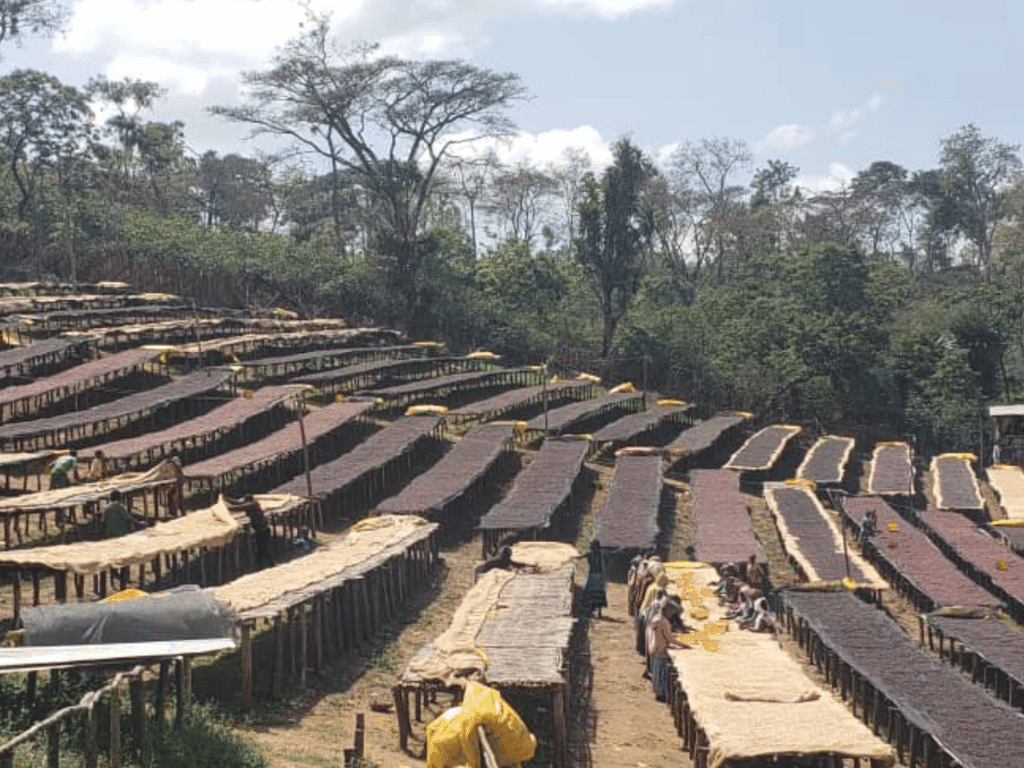
By the 15th Century, coffee began being grown and exported from Ethiopia to Yemen. In the 16th Century, it started to gain popularity in Iran, Turkey, Egypt, and Syria.
The demand for coffee continued to grow, and by the 17th Century there was a rise in coffee plantations in Asia. The Dutch attained coffee seedlings in the latter half of the 17th Century and first tried to grow them in India but failed. They turned their attention to Java, Indonesia. The trees thrived, and with this, the Dutch expanded to the islands of Sulawesi and Sumatra.
Coffee remains Ethiopia’s biggest export and is deep rooted in Ethiopian culture, rituals, and traditional coffee ceremonies.

There are four regions best known for coffee growing, however there are 10 regions in total: Oromia, the Southern Nations, Nationalities, and People’s Region (SNNPR), Gambella, and Sidama.
Within these regions, there are further recognized coffee zones including Lekempt, Jimma (Limu), Yirgacheffe, and Harrar. These are some of the most well-known growing regions known to produce some of the highest quality coffee beans globally.
Photo Credit: Mercanta, The Coffee Hunters
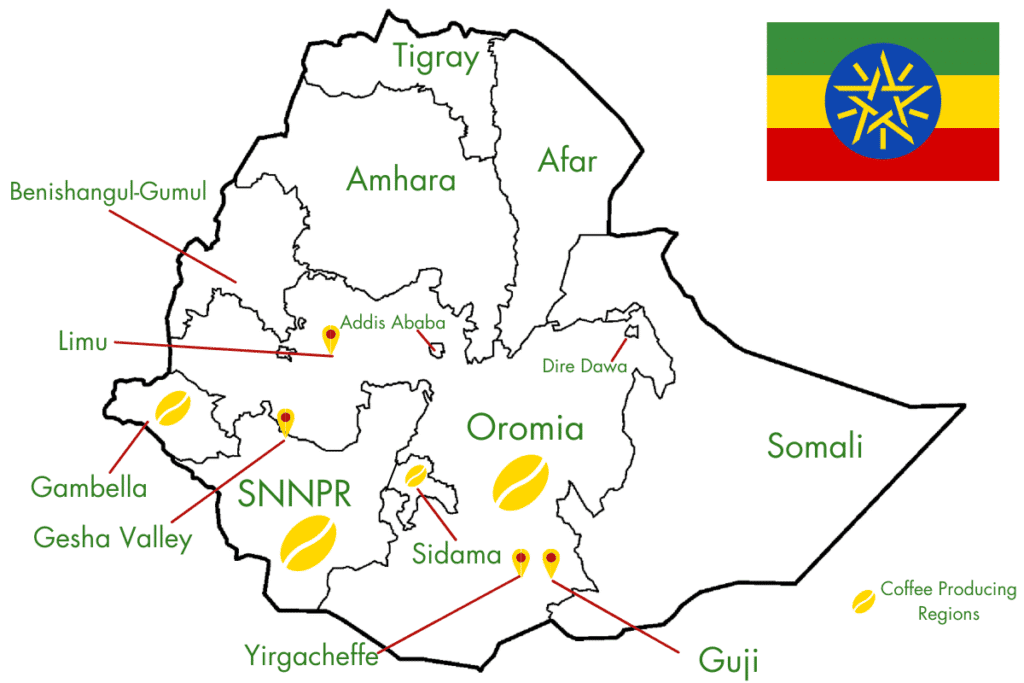
Located in the south, Sidamo is renowned for its high-quality Arabica coffee, characterized by its floral notes, bright acidity, and citrus-like quality. Coffees from Sidamo often exhibit flavors of lemon and bergamot, making them highly prized.
Within Sidamo lies Yirgacheffe, a region that has gained a reputation in its own right for producing some of the most exquisite coffees in the world. Yirgacheffe coffees are known for their floral and tea-like qualities, light body, and high acidity.
In the eastern part of the country, Harrar is famous for its dry-processed (natural) coffees, which offer a bold, winey quality with complex fruit and spice notes. The beans from Harrar are often used in espresso blends for their strong flavors and full body.
Jimma is located in the southwest of Ethiopia and is known for both wet and dry-processed coffees. The region produces coffees with a range of flavors, from fruity and floral to spicy and herbal, depending on the processing method.
Guji, lying to the south of Sidamo, is a relatively new coffee-producing region that has quickly gained recognition for its high-quality coffee. The coffees from Guji are noted for their floral, berry, and chocolate notes, along with complex acidity.
There are tens of thousands of varieties that still grow wild in the forests of Ethiopia. There is a lack of genetic testing, which means for most coffees from Ethiopia, they are given the generic term of “heirloom” or “landrace” as umbrella terms. Heirlooms and landraces are associated with specific regions and are often used interchangeably; there are a few differences. Heirlooms have been traditionally cultivated whereas landraces have adapted naturally to local areas and are shaped by natural selection.
Heirloom varietals are often prized for their unique flavor profiles, which are often described as complex and nuanced with notes of fruit, flowers, and spices.
Other varieties that Ethiopia produces are Bourbon, Typica, and Caturra. Often grown at lower elevations, they tend to have more classic characteristics and flavor profiles.
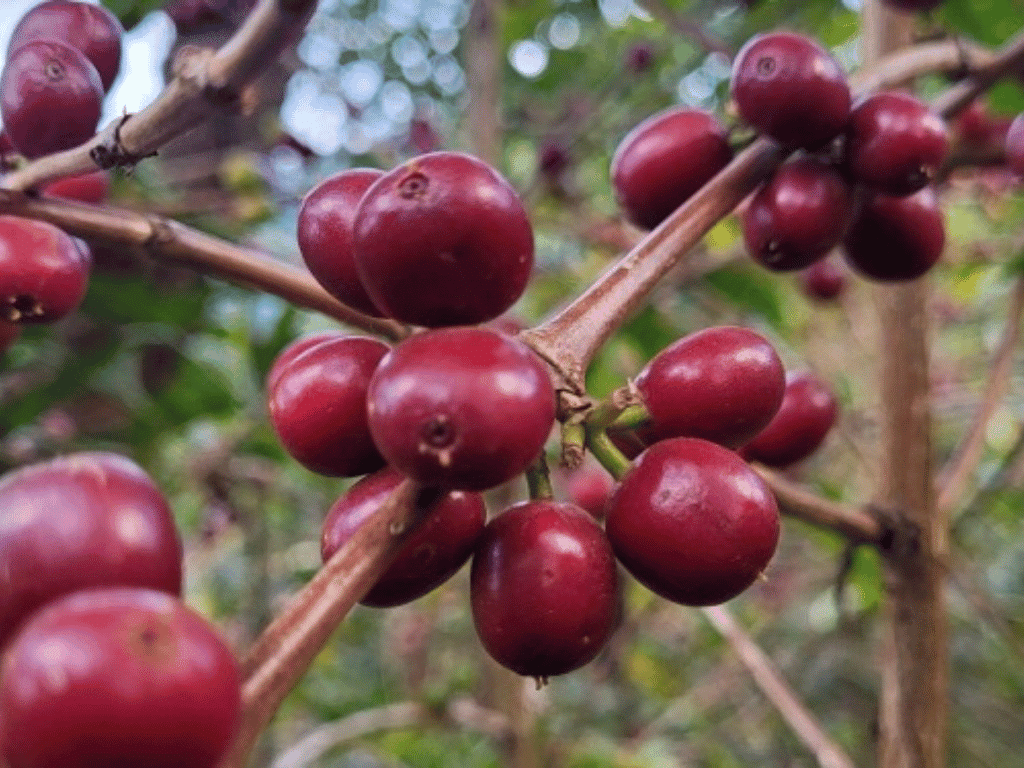
Ethiopian coffee is grown at some of the highest altitudes in the coffee-growing world. Coffee plants are quite sensitive to altitude, location, and soil, meaning that many factors affect the resulting flavour and characteristics.
Coffee is grown at a variety of elevations, from sea level to upwards of 2,000 meters above sea level. Coffee grown at higher altitudes matures more slowly, which often leads to a richer and more complex flavor profile. The cooler climate also allows the cherries to develop gradually, helping create more nuanced tastes in the final cup. In contrast, coffee cultivated at lower elevations ripens faster because of warmer temperatures, producing beans with a simpler and more traditional coffee flavor that is typically less layered or complex.
Different regions are best known for their own characteristics. Yirgacheffe is known for its light, floral notes of stone fruit and citrus. Sidamo is known for its full-bodied, sweet notes of chocolate and berries. Harar is known for bold, earthy notes with hints of spice and fruit.
Coffees from Ethiopia are famous for their lively acidity, often characterized as crisp, fruity, or slightly tangy. This brightness gives the coffee a fresh, vibrant quality and helps highlight its other flavor notes. The mouthfeel can range from light and delicate, like tea, to a smoother medium body, influenced by factors such as the growing region, elevation, and the way the beans are processed.
Because Ethiopian coffee is often grown at very high elevations, the cherries are typically picked by hand and then delivered to local processing stations where they are carefully sorted. Traditional processing methods are still widely used, which is why many Ethiopian coffees have bold, wine-like and fruit-forward flavors. A large portion of the country’s specialty coffee is naturally processed — especially in the Harrar region — giving these coffees their intense, berry-like character.
At the same time, some regions are exploring different processing techniques. Washed coffees are becoming more common in southern areas, including the well-known Yirgacheffe region. Part of the larger Sidamo area, Yirgacheffe is one of the most celebrated coffee-growing regions in the world. It is famous for producing outstanding specialty Arabica coffees, and its washed processing method often results in bright floral notes and crisp citrus flavors in the cup.
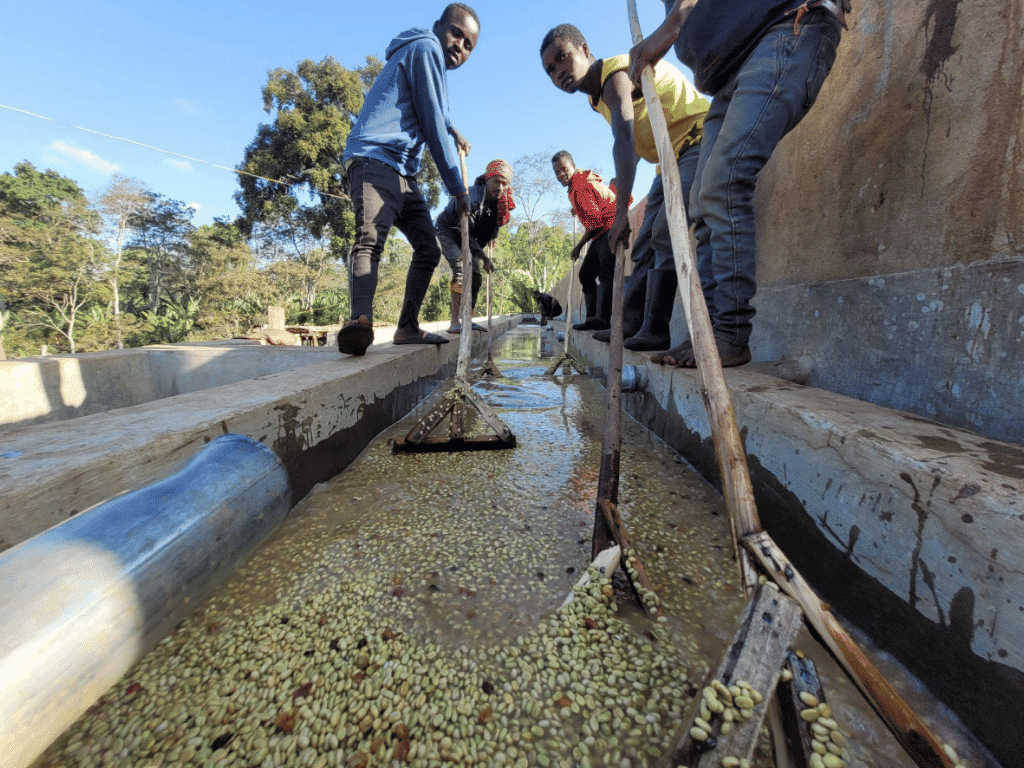
Ethiopia holds a special place in the world of coffee as it is widely regarded as the birthplace of coffee. Wild populations of Coffea arabica are believed to have originated in the country’s forests, particularly in regions such as Kaffa. Because of this natural origin, Ethiopia has an extraordinary diversity of coffee varieties, which contributes to the wide range of unique and complex flavors found in its coffees.
Ethiopia is also home to several world-famous coffee regions, including Yirgacheffe, Sidamo, and Harrar. These areas produce distinctive coffees known for floral aromas, bright citrus notes, and rich fruit-like flavors. Beyond production, coffee is deeply woven into Ethiopian culture, where the traditional coffee ceremony remains an important symbol of hospitality and community.
An honest conversation about harvest variation, and how factors like rainfall, temperature, and crop cycle affect what ends up in the bag.

High altitude, diverse microclimates, and a coffee culture built over generations. Colombia isn’t just an origin — it’s a category of its own.